
 Safety Glasses
 Nitrile Gloves
 Vacuum Pump
 Vacuum Pump Power Steering Adapter (Optional)
 Power Steering Fluid
 Jack
Jack
 Jack Stands
 Drain Pan
 Shop Rags
After checking your service manual for maintenance intervals and procedures specific to your vehicle, flush and refill your power steering fluid with these helpful instructions. Your owners manual will provide the recommended maintenance interval for your power steering fluid, the recommended type of fluid used in your vehicle, and where you can find the fluid reservoir.

Step 1: Inspect the Fluid
If you aren’t sure whether your power steering fluid needs to be flushed, remove the cap and use a flashlight to inspect the fluid. If it smells burnt, is a dark brown or black color, or has metallic debris in it, it should be flushed and refilled with fresh fluid. If there are black particles in the fluid, it’s also an indicator that the power steering hoses may be failing internally and should be replaced, then the system will need to be flushed before refilling.

Step 2: Prep the Vehicle
Make sure the vehicle is parked on a level surface and open the hood. Chock the rear wheels and use a jack and jack stands to lift and support the front end, if needed.
If your vehicle has a splash guard under the steering system, use the appropriate tool to remove it for access.

Step 3: Position Your Catch Basin
Place a catch basin directly under the steering pump and hoses.

Step 4: Drain the Old Power Steering Fluid
Drain the old power steering fluid by removing as much fluid from the pump or reservoir as possible, either by disconnecting the return hose at the pump and letting the fluid drain, or using a vacuum pump or other tool to extract fluid from the system.
Be prepared for the fluid to start draining as soon as the return hose is detached. For reference, the power steering return hose is typically held in place with a clamp as opposed to a hydraulic fitting like the high-pressure lines connected to the pump. Make sure your return hose is draining into the catch basin or bucket.

Step 5: Disconnect the Ignition Coil Fuse
At this point you’ll want to disable the vehicle to prevent it from starting, but allow you to crank the engine over. To do this, you can disconnect the ignition coil fuse, and it may also be a good idea to remove the fuel pump relay to prevent fuel from flooding the engine while cranking.

Step 6: Remove the Power Steering Fluid Reservoir Cap
Now, cap the return line on the power steering pump and remove the cap on the power steering fluid pump or reservoir.

Step 7: Add Recommended Amount of Fluid
Add the manufacturer-recommended amount of fluid to the reservoir. Now have a friend crank the engine for a few seconds to pump old fluid out of the return hose. Stop cranking and add more fluid as needed. Never let the power steering pump run dry, as this can cause damage to the pump.
Once the fluid that’s draining is obviously new fluid, you can reattach the return hose.
If you choose to, you can also add an in-line power steering fluid filter to the return hose to catch debris before it reaches the pump. This is not necessary, but is a recommended step for the longest pump life.
Now you can refill the reservoir with the type and amount of power steering fluid recommended by your vehicle’s manufacturer.

Step 8: Remove the Catch Basin and Replace Fuses
Remove the catch basin from under your vehicle, and replace any fuses you may have removed to disable the engine.

Step 1: Secure a Vacuum Pump
We’ll be demonstrating bleeding the system with the Mityvac MV8000 vacuum pump. The only other part you might need for this is the MVA660, which is a universal adapter specifically designed to make a tight seal on power steering reservoirs.

Step 2: Park the Vehicle
Park on a level surface and open the hood.

Step 3: Remove the Cap
Take the cap off your power steering fluid reservoir.

Step 4: Set Up Your Vacuum Bleeding Tool
Secure the pump hose at the body of the tool. Find the appropriate fitting or adapter for the other end of the hose. The right fitting will need to attach to the opening of your fluid reservoir to create a seal.

Step 5: Squeeze the Pump Handle to Bleed the System
Once the hose is attached and the seal is created, squeeze the handle of the pump until the gauge reads about 15 inches of mercury, then let it sit for about 5 minutes.

Step 6: Check the Fluid Level
Release the pressure, check the fluid level, and top it off if needed.

Step 7: Repeat Steps 5 and 6
Repeat these steps at least one more time to ensure all air has been bled from the power steering system.
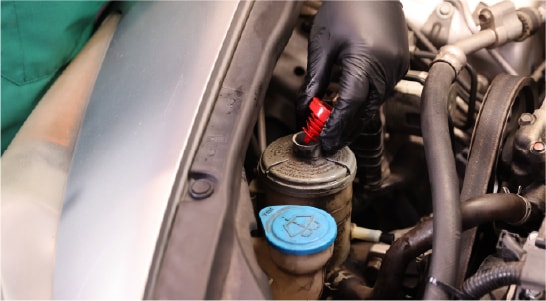
Step 8: Replace the Reservoir Cap
If the fluid level looks good, you can replace the cap on the reservoir.

Step 9: Check the Fluid Level Again
Start the engine and let it warm up to operating temperature. Check the fluid level again and top it off if necessary.
Repeat the entire procedure until the fluid level remains steady, indicating that all the air is out of the system. Once the fluid level is steady, you’ve completed your power steering bleed procedure.

Step 1: Park on a Level Surface
Park on a level surface and open the hood.

Step 2: Chock the Wheels
Chock the rear wheels. Lift and support the front end with your jack and jack stands.

Step 3: Remove the Reservoir Cap
If you haven’t already, remove the cap from the power steering fluid reservoir and make sure the fluid is at the manufacturer-recommended level.

Step 4: Turn the Wheel
From inside the vehicle, turn the key to the ON position to release the steering wheel lock. Without starting the vehicle, turn the wheel one full turn in one direction, back to center, and then one full turn in the opposite direction.

Step 5: Repeat Previous Step
This will be difficult to do with the engine turned off, but you’ll need to repeat turning the steering wheel one full turn in both directions 2 to 3 times.

Step 6: Check the Fluid Level
Once you’ve done this, check the power steering fluid level and top it off if needed.

Step 7: Start the Vehicle
Now start the vehicle and perform the same procedure a few more times. You may hear some noise from the power steering pump as you start this procedure, but it should go away as you continue to turn the wheel. Once you’ve turned the steering wheel one full turn in both directions a few times, turn the steering wheel all the way in one direction until it stops, then turn it back the opposite direction until it stops.

Step 8: Turn off the Engine and Check the Fluid Level
Turn off your engine and check your fluid level again. If necessary, top it off. Once you’ve completed these steps, your steering wheel should be easy to turn, and the power steering pump shouldn’t be making any noise. As long as the power steering level is remaining consistent, the bleed procedure is complete.

Step 9: Lower Your Vehicle
Lower the front end of your vehicle and remove the wheel chocks.

Step 10: Replace the Reservoir Cap
Replace your power steering fluid cap and close the hood.


