Warning Sorry, you're using a web browser that is no longer supported. For the best experience please upgrade or visit the site on another browser.
Skip to content

How to Replace the Brakes Pads and Rotors on a 2013 to 2018 Toyota RAV4

Your Toyota RAV4 XLE’s brake pads and rotors are integral parts of your vehicle’s braking system that help slow your truck down when you apply pressure to the brake pedal. The brake pads clamp onto your vehicle’s brake rotors to slow the wheels while they’re spinning, stopping your vehicle smoothly. If you need to replace your Toyota’s brake pads or rotors, you may experience vibrations in your brake pedal, or hear squealing or grinding sounds when braking. Worn, failing, or malfunctioning brake pads or brake rotors can negatively impact your vehicle’s braking distance and handling, and could put you and others on the road in danger.

Tools & Materials List

Step-by-Step Instructions

Remove Your Old Rotor

Install Your New Rotor

Install Your New Brake Components

Additional Resources

Tools & Materials

Step-By-Step Instructions to Change the Brakes on Your RAV4

Replacing worn brake pads and rotors is a routine automotive maintenance task that can be completed at home with the right tools and supplies. When completing your DIY brake pad and rotor replacement, it’s recommended that both the brake pads and rotors be replaced at the same time, since the brake pads and rotors have experienced the same amount of wear at the same rate. These detailed steps show how to change the front brake pads and rotors on a 2016 Toyota RAV4 XLE, but will be similar on 2013, 2014, 2015, 2017, and 2018 models.

This page will demonstrate how to change the front brake pads and rotors on a 2017 Toyota RAV4. Procedures will be similar for most RAV4 models from 2013 to 2018, but be sure to know the specifics for your vehicle before getting started.

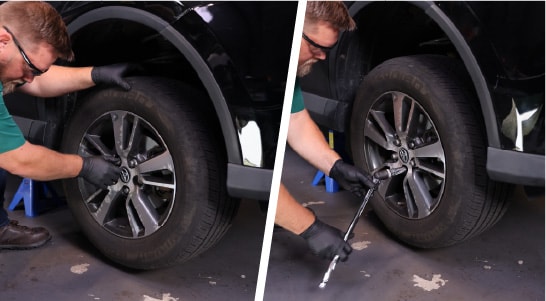
In two images, a 2016 Toyota RAV4 is parked level and our expert uses a breaker bar to loosen the front passenger wheel’s lug nuts.

Step 1: Prepare Your RAV4

Park on a level surface. Use a breaker bar and 21mm socket or lug wrench to loosen the lug nuts on your front wheels.

Our expert chocks the RAV4’s back wheels.

Chock the rear wheels.

In two images, our expert lifts the front end of the vehicle using a hydraulic floor jack and secures it with jack stands.

Step 2: Lift Your Vehicle

Lift and support the front end of the vehicle.

The front wheel is removed from the vehicle.

Step 3: Remove Your Front Wheels

Remove the lug nuts and the front wheels.

Remove Your Old Brake Rotor

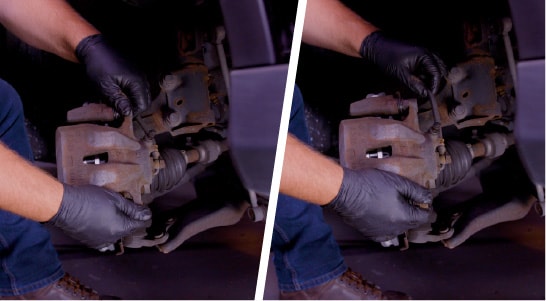
Use a flathead screwdriver between the rotor and brake pad to compress the caliper piston slightly just enough to remove the caliper from the rotor.

Step 4: Separate Your Brake Caliper from Your Rotor

Use a flathead screwdriver between the rotor and brake pad to compress the caliper piston slightly just enough to remove the caliper from the rotor.

The caliper bolts are removed using a ratchet and socket.

Step 5: Remove Your Caliper Bolts

Use a ratchet and 14mm socket to loosen and remove the caliper bolts.

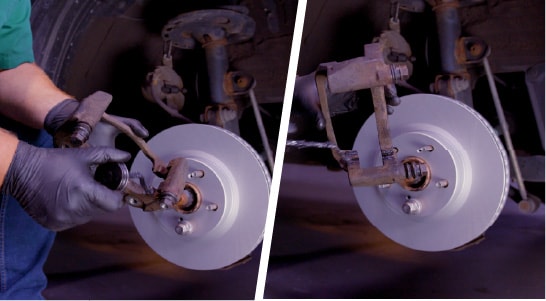
In two images, the caliper is taken off the old rotor and suspended in the wheel well, out of the way.

Step 6: Remove Your Brake Caliper

Slide the caliper off the rotor and suspend it somewhere out of the way, making sure there’s no pressure on the brake hose.

The caliper bracket mounting bolts are loosened and removed using a breaker bar. The caliper bracket is removed with the brake pads.

Step 7: Remove Your Bracket Mounting Bolts

Use a ratchet or breaker bar and 17mm socket to loosen the two caliper bracket mounting bolts and remove them. Remove the caliper bracket with the brake pads in it and set it aside for now.

The bolts for the old rotor are loosened with a breaker bar and a hammer in order to be removed fully.

Step 8: Remove Your Old Rotor

Remove your old rotor. If the rotor doesn’t come off easily, you can use its two holes to thread an M8-1.25 bolt into the hub to help push it off. You can also use a hammer to loosen it, but only if the rotor will be replaced.

Install Your New Rotor

Brake cleaner is applied to the rotor and wiped down with a shop towel.

Step 9: Wipe Down Your New Rotor

Use brake cleaner and a shop towel or rag to wipe any oils from the friction surfaces of your new rotor. Clean any rust off the hub with a wire brush.

Do It Right: Any time you use brake cleaner, remember that it will strip paint, so be very careful where you spray it.

Silicone brake grease is applied to the hub before installing the new rotor.

Step 10: Apply Silicone Grease

Adding silicone brake grease to the hub before installing your new rotor will make it easier to remove it during your next brake service.

In two images, the new rotor is installed and one of the wheel lug nuts is screwed in to hold it in place.

Step 11: Install Your New Rotor

Install your new rotor, and use one of your wheel lug nuts to hold it in place as you continue to work.

The caliper piston is wiper down with a shop towel.

Step 12: Clean Your Caliper Piston

Wipe the exposed portion of your caliper piston with brake cleaner on a towel or rag. If the rubber boot is cracked or if there’s brake fluid leaking, the caliper needs to be replaced.

The brake bleeder tool is attached to the caliper and opened.

Step 13: Attach Your Brake Bleeder Tool

Attach your bleeder tool and open the bleeder valve by turning it counter-clockwise.

In two images, the caliper piston is compressed and released.

Step 14: Use Your Caliper Compressor Tool

Using an old brake pad to protect the piston, compress the brake caliper with a brake caliper compressor tool. When you’re done, the piston should be flush with the housing.

The brake bleeder valve is disconnected.

Step 15: Disconnect Your Bleeder Tool

Tighten the bleeder valve, being careful not to let any air into the line. Detach the bleeder tool.

Remove Your Old Brake Hardware

In two images, the old brake pads and hardware are removed from the caliper bracket.

Step 16: Remove Your Old Brake Components

Remove the old pads and hardware from your caliper bracket, taking note of their orientation, so you can install your new ones properly and give the bracket a visual inspection. If the bracket is extremely rusty where the pads or hardware will sit, it needs to be replaced.

Our expert visually inspects the slide pins to check their quality.

Step 17: Check Your Slide Pins

Remove the slide pins, and visually inspect them. If they’re corroded or pitted, they also need to be replaced.

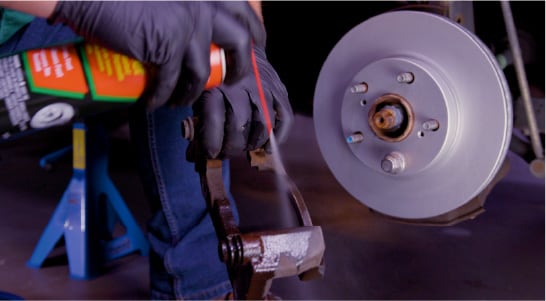
The caliper bracket is sprayed down with O’Reilly Brake Cleaner.

Step 18: Apply Brake Cleaner

Spray the bracket down with brake cleaner, but don’t use a wire brush to clean it. This can lead to further corrosion.

In two images, the slide pins have fresh grease applied and are reinstalled.

Step 19: Reinstall Your Slide Pins

Wipe down the slide pins and apply some fresh silicone grease. Reinstall the pins, and make sure they glide smoothly.

Fresh silicone grease is applied to the notches in on the caliper bracket.

Do It Right: You’ll also apply silicone grease to the notches on the bracket where your new brake hardware will sit as well as the back of your new brake pads.

Install New Brake Hardware

New brake pads are installed onto the vehicle.

Step 20: Install Your New Brake Components

Install the new hardware and brake pads.

The brake caliper bracket is reinstalled to the vehicle.

Step 21: Reinstall Your Brake Caliper Mounting Bracket

Reinstall the bracket. Lift it into place, with the pads on either side of the rotor, and thread the 17mm bracket bolts by hand, starting with the top one.

The bracket bolts are tightened with a ratchet and socket.

Step 22: Tighten Your Bracket Bolts

Use your ratchet and socket to tighten the bolts, then use your torque wrench to tighten those bolts to 79 foot-pounds.

In two images, our expert moves the caliper over the brake pads.

Step 23: Reinstall Your Brake Caliper

Move the caliper into place over the pads, making sure the brake hose isn’t twisted.

In two images, the caliper mounting bolts are threaded by hand and then tightened with a ratchet.

Step 24: Reinstall Your Caliper Mounting Bolts

Thread the two mounting bolts by hand, starting with the top one. Use your ratchet and 14mm socket to tighten them. Once they’re snug, torque these bolts to 25 foot-pounds. If you used a lug nut to keep the rotor in place, you can remove it now as well as your caliper hanger.

The front passenger wheel is replaced and the lug nuts are replaced and tightened.

Step 25: Reinstall Your Wheel

Reinstall the wheel and tighten the lug nuts until the wheel is secure against the rotor.

Do It Right: It’s always a good idea to change brake pads and rotors in pairs, so repeat these steps on the other side.

In two images, our expert lowers the RAV4 with the floor jack and removes the chocks from the rear wheels.

Step 26: Lower Your RAV4

p>Lower the front end and remove the wheel chocks.
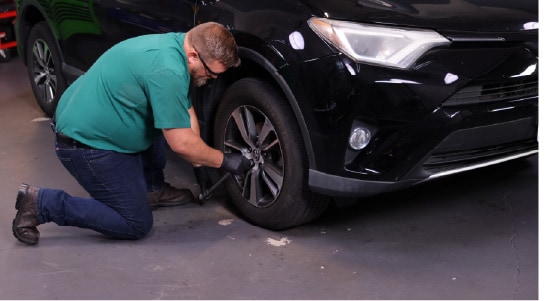
Now that the RAV4 is parked level, our expert tightens the wheel lug nuts using a socket and torque wrench.

Step 27: Torque Your Wheel Lug Nuts

Use your 21mm socket and torque wrench to tighten the nuts in a star pattern to 76 foot-pounds.

Do It Right: Once your job is complete, be sure to pump your brake pedal several times until you feel the pressure return. Make sure to do this before you drive anywhere!

Final Tutorial Steps

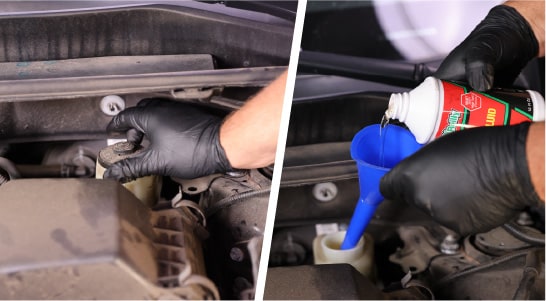
In two images, our expert checks the brake fluid level and adds more fluid8 to the master cylinder.

Step 28: Check Your Brake Fluid

Some brake fluid was pushed out when you compressed your caliper pistons, so check your master cylinder and add fluid as needed.

If your brake pedal feels spongy, it’s likely that you have air in one or both of your front brake lines. Check out our video on how to bleed your brake lines to remove the air if needed.

A foot presses the brake pedal to test the quality of the new brake components.

Step 29: Test Your New Brakes

To help break in the new components, it’s a good idea to test drive your vehicle, slowing it thirty times from thirty miles per hour with moderate brake pressure, allowing the brakes to cool for about thirty seconds in between each slowdown. Try to avoid aggressive stops during this break-in process. Your brakes will probably smell after you’ve done this, and that’s okay. If the odor persists past five hundred miles or so, or if you have excessive dust on a wheel, you may have a stuck caliper.

Additional Resources

Replacing worn brake pads and rotors is a routine automotive maintenance task that can be completed at home with the right tools and supplies. When completing your DIY brake pad and rotor replacement, it’s recommended that both the brake pads and rotors be replaced at the same time, since the brake pads and rotors, since they have experienced the same amount of wear and are likely to fail at or around the same time. These detailed steps show how to change the front brake pads and rotors on a 2016 Toyota RAV4 XLE, but will be similar on 2013, 2014, 2015, 2017, and 2018 models. We also recommend checking your vehicle’s owners manual for steps specific to your vehicle before completing your DIY brake job. Our detailed step-by-step instructions will help you perform a brake rotor and brake pad replacement on your Toyota RAV4 to keep your brakes performing as they should and keep you safe while driving.

The automotive repair work depicted in this series is performed under the direction of the manufacturer of the product featured. Prior to undertaking any of the demonstrated repairs on your vehicle, we suggest you consult with a certified mechanic or another professional who can adequately advise you of the proper repair or remedy required. O’Reilly Automotive Stores, Inc. and its affiliates (“O’Reilly”) disclaims any responsibility for injury or damage resulting from a viewer’s attempt to recreate the repairs shown in this series.