


The A/C system in your car uses refrigerant to pull heat out of the cabin. It does this by cycling refrigerant through the compressor, condenser, and evaporator, a heat exchanger that absorbs warmth before the blower motor pushes the air through the vents. Knowing how each part works makes it much easier to pinpoint exactly what’s causing the problem when your A/C stops working. This guide covers the refrigeration cycle, what each component does, common failure symptoms, and how to choose the right refrigerant and compressor oil for your vehicle’s next A/C repair.
A common misconception is that your car’s air conditioning system creates cold air. Instead, the refrigeration cycle moves heat out of your cabin by cycling refrigerant between gas and liquid states. As refrigerant changes state and its temperature is reduced, it draws heat out of the air passing over it, which is what actually cools your cabin.
If your system has a refrigerant leak, you’ll notice the effects almost immediately: intermittent cool air, weak airflow, or no cooling at all, leading to an uncomfortable cabin or fog on the insides of your windows. The A/C system also relies on refrigerant oil to lubricate and seal its components, so if you have too little refrigerant and oil, it can lead to inefficient cooling, compressor failure, or damage to other parts that will need repair before the system can be recharged.
There are two main types of automotive A/C systems:
- Thermal Expansion Valve (TEV, TXV, or TX): Uses an expansion valve to regulate how much refrigerant reaches the evaporator.
- Clutch-Cycling Orifice Tube (CCOT): Uses a fixed orifice tube instead of a variable valve, cycling the compressor’s clutch on and off to control cooling.
Both are closed systems, meaning refrigerant stays inside and doesn’t need to be added or removed under normal conditions. For either system to work correctly, it needs the right amount of refrigerant and oil, and no leaks can be present.
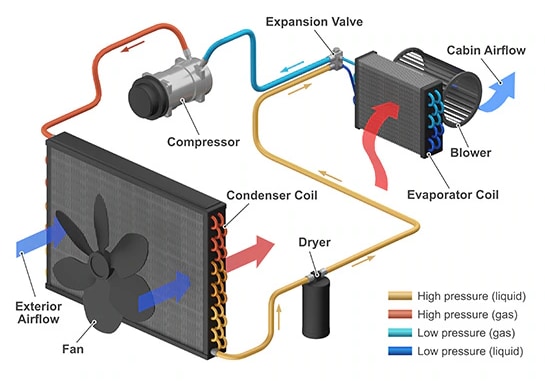
Automotive A/C systems are divided into high-pressure and low-pressure sides, which change the state and temperature of the refrigerant as it moves through the system. The compressor, condenser, and evaporator are the three main parts of the system, working alongside components like the condenser fan, receiver-drier or accumulator, expansion valve or orifice tube, and blower motor. Refrigerant enters the high-pressure side first, where the compressor pressurizes it into a hot gas.
A/C Compressor
The A/C compressor is the component that begins the high-pressure side of your A/C system. Driven by the engine’s accessory belt, it draws in and compresses low-pressure refrigerant gas into a hot, high-pressure gas that gets pushed through the rest of the system.
A/C Condenser
After the compressor pressurizes the gas, it moves to the A/C condenser, which is a heat exchanger that cools it from a high-pressure gas into a high-pressure liquid. The condenser works similarly to a radiator, using coils and heat-exchanging fins to dissipate heat as air passes through the grille or is pushed or pulled through the condenser by the cooling fan(s).
Cooling Fan Assembly
A cooling fan pushes or pulls air across the condenser fins to speed up cooling, especially at idle when there isn’t enough airflow through the grille. Depending on the vehicle, you may have a specific condenser fan, or you might rely on the radiator cooling fan to draw air through both heat exchangers. Modern vehicles also typically rely on electric fans, but on older vehicles or heavy-duty applications, mechanical or clutch fans may be used to cool both the radiator and the condenser.
A/C Receiver-Drier
Found only on Thermal Expansion Valve (TEV) systems, the A/C receiver-drier sits between the condenser and the expansion valve. It filters debris and absorbs moisture using an internal desiccant material, protecting the system from corrosion and clogs. Because that desiccant material breaks down over time and can quickly absorb moisture if exposed to the outside air, the receiver-drier assembly should be replaced any time the A/C system is opened for service.
A/C Expansion Valve
In TEV systems, the A/C expansion valve is the dividing line between the high- and low-pressure sides. It lets high-pressure, warm liquid refrigerant expand into a cold, low-pressure liquid, and it opens and closes to control how much refrigerant reaches the evaporator, preventing it from freezing.
A/C Orifice Tube
CCOT systems use an orifice tube in place of an expansion valve. It performs the same basic function as the valve, expanding warm, high-pressure liquid refrigerant into a cold, low-pressure liquid, but has no moving parts to regulate flow. Because of that, some liquid refrigerant exits the evaporator instead of vapor, which is why CCOT systems use an accumulator to catch the liquid before it reaches the compressor.
In-Line A/C Filter
Some Clutch-Cycling Orifice Tube systems use an in-line A/C filter, installed in the liquid line ahead of the orifice tube, to catch metal or plastic debris from a failing compressor before it can cause a blockage. These aren’t standard on every vehicle, so you may need to refer to your service manual to determine if your car is equipped with an A/C filter that needs regular maintenance.
A/C Evaporator Core
Located inside the cabin, the A/C evaporator core absorbs heat from the evaporator case as cold refrigerant passes through the core. The blower motor pushes air over the evaporator’s fins, which cools the cabin air and warms the refrigerant into a high-temperature gas headed back to the A/C compressor.
A/C Accumulator
CCOT systems use an A/C accumulator in place of an A/C receiver-drier. It filters and stores refrigerant the same way a receiver-drier does, but is larger to accommodate the unregulated flow of refrigerant coming from the orifice tube. The accumulator holds that leftover liquid refrigerant in reserve until it finishes evaporating into gas. This keeps it out of the compressor where it could cause damage until it has reached the appropriate state for further cycling.
A/C Blower Motor
The blower motor pushes air over the cold evaporator fins as the refrigerant absorbs heat from the climate control case under the dash. This creates cool air that blows through the vents and into the cabin, completing the A/C refrigeration cycle. The blower motor is also used when heating the cabin, where the air the blower motor is instead directed over the hot coils of the heater core.
Learn how to replace a blower motora> or blower motor resistor if yours is showing signs of failure.
High- & Low-Pressure A/C Hoses & Return Lines
A/C hoses and lines move refrigerant to and from each component as it cycles through the system, and can be part of either the high- or low-pressure side, depending on where they’re located. In most A/C systems, there are three types of hoses:
- Suction Line: Pulls refrigerant vapor from the evaporator or accumulator to the compressor
- Discharge Hose: Carries pressurized refrigerant vapor from the compressor to the condenser
- Liquid Line: Carries liquid refrigerant from the condenser to the expansion valve or evaporator
Since hoses, fittings, and O-rings can wear out over time, checking their condition is usually the first place to look if you suspect a refrigerant leak.
It’s also important to replace O-rings any time connections in the system are disassembled, and to ensure that the correct O-ring type is used based on the refrigerant type that your vehicle requires. Modern A/C systems, including those charged with both R-134a and R-1234yf refrigerants, typically use green HNBR (Hydrogenated Nitrile Butadiene Rubber) O-rings to ensure a complete, long-lasting seal.
Your A/C system relies on two fluids to work: refrigerant and refrigerant oil. Refrigerant cycles between liquid and gas states to absorb and release heat, producing the cool, dry air that comes through your vents. Refrigerant oil lubricates and seals the system’s moving parts, protecting the compressor from friction and damage. Without the correct amount of both, your A/C system can’t build the pressure needed to cool properly or resist premature wear.
Low refrigerant levels are one of the most common causes of A/C failure, often causing warm or lukewarm air from the vents. Because the system is sealed, low refrigerant levels almost always point to a leak somewhere in the components, seals, hoses, or fittings. Refrigerant loss is also more serious than it sounds; losing just 10% of your system’s refrigerant can be as damaging as losing 40% of your engine’s motor oil.
Refrigerant leaks are often hard to catch since refrigerant usually escapes as a vapor rather than a visible liquid. If you notice water underneath your car after running the A/C, that’s typically just normal evaporator condensation, not a leak. An A/C leak detector can help you find leaks that are hard to see. Refrigerant leak detectors come in two varieties, including UV dye with a special light to find leaky areas, or a refrigerant sniffer that detects refrigerant concentration near leak points.
Always check your owners manual for the refrigerant type and amount your car needs, and use a refrigerant oil that’s compatible with your vehicle. Using the wrong oil or refrigerant can shorten the life of your compressor, hoses, and fittings. If you’re not sure which to choose for your vehicle needs, visit your local O’Reilly Auto Parts store. Our parts professionals can help you find the right refrigerant, oil, and chemicals for the job.
Types of Car A/C Refrigerant: R-134a vs. R-1234yf
Your car most likely uses one of two refrigerants: R-134a and R-1234yf. To find out which one your car requires, check the A/C system label under the hood, usually on or near the compressor, or look up the specification in your owners manual.
R-134a
R-134a is the standard refrigerant in most vehicles today, replacing R-12 in the 1990s. If your car was made before 1995, the A/C system can often be retrofitted to use R-134a safely.
R-1234yf
R-1234yf is the newest type of refrigerant, and it significantly reduces environmental impact compared to R-134a. A few automakers started using it as early as 2014, and the EPA has required it in all new U.S. vehicles since model year 2021.
R-12
R-12 refrigerant was phased out by the mid-1990s because of its effect on the ozone layer. If your car still has an R-12 system, it can be converted to run R-134a with an R12 to R134a conversion kit and adapter. In some cases, this may require more extensive modification, as some of the seals and hoses weren’t designed to prevent escape of the smaller R-134a molecules.
Types of A/C Compressor Oil: PAG vs. Ester
Your A/C system also needs a compressor oil that matches your refrigerant type and the viscosity your system calls for. Using the wrong oil can cause premature wear on the compressor and, over time, cause it to fail.
PAG (Polyalkylene Glycol) Oil
PAG (Polyalkylene Glycol) oil is the most common oil used in automotive A/C systems today and is compatible with both R-134a and R-1234yf. It’s available in several viscosities, including PAG 46, PAG 100, and PAG 150.
Ester (POE) Oil
Ester (POE) oil is compatible with both R-12 and R-134a systems and can be mixed with the mineral oil originally used with R-12. It’s used less often than PAG oil today, has fewer viscosity options, and offers less component protection. Ester oil is especially useful when converting from R-12 to R-134a, as using PAG oil in these systems can cause an adverse reaction from any remaining mineral oil that may limit the amount of protection offered.
If your vents aren’t blowing cold air, or you notice a burning smell, rattling noises, or water on the passenger floorboard, it can be challenging to determine which component is causing your A/C to stop working. The table below lists each component, common symptoms, and solutions.
| A/C Component | Symptoms | Possible Cause | Testing & Service Tips |
|---|---|---|---|
| Compressor |
No cold air, inconsistent cooling, refrigerant leaks | Compressor, belt, pulley clutch, or relay | Inspect for leaks, listen for squeaking or squealing, check the belt and pulley for wear, test electrical connections with a voltage tester, and observe whether the clutch is activating and deactivating appropriately |
| Condenser |
Warm air, burning smell, refrigerant leaks | Condenser or cooling fan | Inspect the condenser for leaks, check cooling fan operation, relay, and connections |
| Receiver Drier/Accumulator |
Refrigerant leaks, film around seals and fittings, rattling noises, moldy smell from vents, desiccant material found elsewhere in the system | Receiver-drier or accumulator | Inspect for leaks or damage; replace if the system has been opened to the atmosphere for service |
| Expansion Valve or Orifice Tube |
Intermittent or no cooling, frost on vents, compressor running continuously, inconsistent air temperature | Expansion valve not cycling properly, or orifice tube blockage | High/low pressure test for blockage, inspect and replace component as needed or if the system is opened to the atmosphere for service |
| Evaporator |
Weak, inconsistent, or no cold air, odor from vents, compressor won’t activate, water leaking onto the passenger floorboard, freezing evaporator | Damaged or clogged evaporator, sensor failure, or expansion valve failure | Inspect for leaks or damage, check evaporator and line temperatures, check the drain tube for clogs |
| Blower Motor |
Weak or no airflow, fan only works at certain speeds, squeaking or squealing, clicking when changing speeds | Blower motor, resistor, fuse, or switch | Check the cabin air filter for restrictions, check blower motor voltage, inspect the fuse, resistor, and switch |
| Hoses |
Refrigerant leaks, A/C not as cold as it should be | Failed hose, O-ring, or fitting | Inspect hoses for leaks or damage, high/low pressure test for blockage |
| Cabin Air Filter |
Reduced or no airflow, mildew odor from vents, decreased A/C performance | Clogged or dirty filter | Inspect and change the cabin air filter |
Whether you’re dealing with a failing compressor, a clogged expansion valve, or a worn-out hose, you’ll find the parts, tools, and chemicals you need to fix your A/C system online at OReillyAuto.com or at your local store. We also carry leak detectors and sealers, along with manifold gauge sets, vacuum pumps, oil injectors, and other specialty tools for a complete A/C repair.
Don’t want to buy a specialty tool for a one-time repair? O’Reilly Auto Parts’ Loaner Tool Program lets you rent A/C tools for a refundable deposit. If you’d rather leave the repair to someone else, we can recommend a Certified Auto Repair center or a trusted professional shop near you that specializes in A/C repair.
What refrigerant does my car need, R-134a or R-1234yf?
It depends on the age of your vehicle and the A/C system. Most vehicles made before 2021 use R-134a, while most vehicles made in 2021 or later use R-1234yf, since the EPA required it in all new U.S. vehicles starting that year. Check your owners manual or the A/C system label under the hood to confirm which one your car takes.
If your vehicle is older than 1994, it may have originally been equipped for R-12 refrigerant, so consider converting the system to accept R-134a or check for a label under the hood or special connector adapters that indicate it has already been converted.
What’s the difference between PAG and Ester oil?
PAG oil is the standard choice for most modern A/C systems and works with both R-134a and R-1234yf. Ester oil is used less often today, mainly in older R-12 systems, and offers less protection and fewer viscosity options than PAG oil, but is not reactive with mineral oil in R-12 to R-134a conversions.
How do I know if my A/C system has a leak?
Warm air or inconsistent cooling is usually the first sign of an A/C system leak. Since refrigerant typically escapes as a vapor rather than a liquid, using a dedicated A/C leak detector, UV dye, or a refrigerant sniffer is often needed to locate the source.
Can I use an A/C recharge kit instead of finding and fixing the leak?
An A/C recharge kit can top off a system that’s low on refrigerant from gradual seepage over time, but if you have an active leak, the new refrigerant will escape the same way the old refrigerant did. Though some refrigerant recharge products offer leak-sealing additives, repairing the leak first and flushing the system to remove debris and contaminated oil before a complete recharge addresses the cause instead of masking the symptom.