Warning Sorry, you're using a web browser that is no longer supported. For the best experience please upgrade or visit the site on another browser.
Skip to content

How to Clean Battery Terminals

Cleaning battery terminals and posts can help remove corrosion and ensure the best possible connection and power transfer. This basic maintenance task typically only takes a few minutes, and is also a necessity to remove any protective coatings that may be used on the terminals of your new battery. To learn more about how to clean and protect corroded battery terminals, read on, or check out our step-by-step video.

Tools & Materials

20% OFF $125+ WITH PROMO CODE: GREEN20, Online Only

20% OFF $125+ WITH PROMO CODE: GREEN20, Online Only

Get 20% off $125 with promo code GREEN20. Online, ship to home only. 04/23/26 – 04/27/26. *Maximum discount $50.

20% off $125+: Valid on regularly priced in-stock items for Ship to Home orders that when purchased together total $125 or more (before tax, shipping and discount) on the website only. Excludes AIRAID, B&M, Bully Dog, DeVilbiss, Edelbrock, Flowmaster, Holley, Hurst, Ingersoll-Rand, K&N, MSD, SCT, and Spectre items.
To Redeem Offer: Add qualifying items totaling $125 or more to your shopping cart and select “Ship” as your delivery method. Enter promo code GREEN20 in the cart. The total in your shopping cart will be adjusted after promo code is applied. Excluded brands contribute toward minimum purchase amount to qualify for offer but are not eligible for discount. (Maximum $50.00 Discount.) Valid Thursday, April 23rd to Monday, April 27th, 2026 (11:59pm Hawaii Time Zone). Coupon code is not redeemable for cash, is nontransferable and cannot be replaced if lost or stolen. Not valid on same-day delivery orders. Void if copied, transferred or where prohibited by law. Customer pays sales tax and shipping fees.

Offer subject to adjustment due to returns, cancellations and exchanges. Additional taxes and duties may apply. Not valid with any other promotional gift with purchase. Offer may be modified or discontinued at any time without notice.

Offer Terms: Offer does not apply to gift card orders. Offer does not apply to Lead-Acid batteries. Cannot be used in combination with any other certificates, offers, or discounts or for payment on account. Not valid on previous purchases or store purchases. Shipping & handling and taxes do not qualify towards the minimum purchase. Valid for retail customers only. OReillyAuto.com only ships orders within the U.S.

Excluded Brands: Offer does not apply to AIRAID, B&M, Bully Dog, DeVilbiss, Edelbrock, Flowmaster, Holley, Hurst, Ingersoll-Rand, K&N, MSD, SCT, and Spectre items.


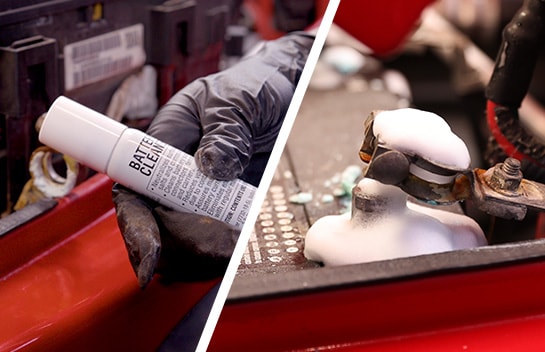
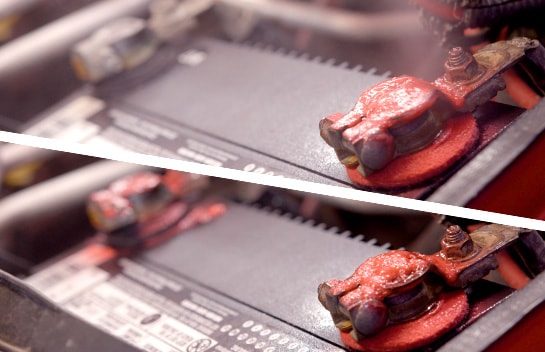
Battery corrosion is typically caused by small leaks around the battery posts that allows battery acid or hydrogen gas to come into contact with the battery terminals. This results in a chemical reaction that causes blue-green deposits to form around the battery terminal and post, forming a barrier that leads to high resistances between the battery post and terminal. Though this is most common in older batteries, it is possible for overcharging to cause hydrogen gas to escape, so it may be a good idea to check your charging system if you notice premature corrosion.


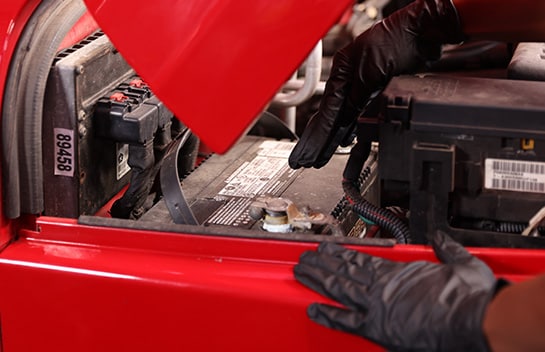
Our O’Reilly expert lifts the hood of their vehicle and locates the battery.

Step 1: Prepare for Cleaning a Battery Terminal

Locate your battery under the hood.

Do It Right: Not all batteries are located under the hood. Some batteries may be found in your trunk, under your vehicle’s floorboard, or behind your vehicle’s wheel well. Make sure to check your owners manual before continuing with this tutorial.

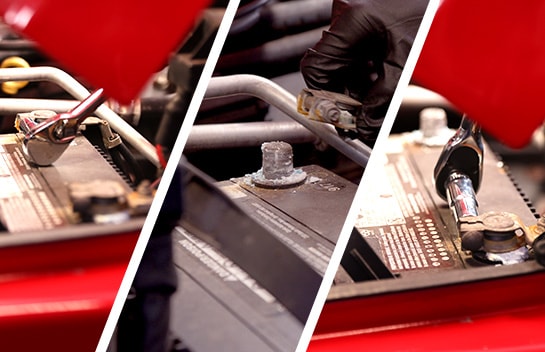
In three images, our expert disconnects the negative battery cable and then the positive cable, in that order.

Use a small wrench or a ratchet and socket to disconnect the battery cables, starting with the negative cable. Once the negative cable is disconnected, then disconnect the positive cable.

Do It Right: Be careful! Make sure the black cable does not touch the red battery cable or come in contact with anything metal.

In two images, our expert holds a small spray can of battery cleaner and sprays it onto the battery.

Step 2: Apply Battery Cleaner

Take your battery cleaner and shake the can before spraying lightly any areas where you see corrosion. This includes the connectors, terminals, tray, hold-down, and the surface of the battery itself.
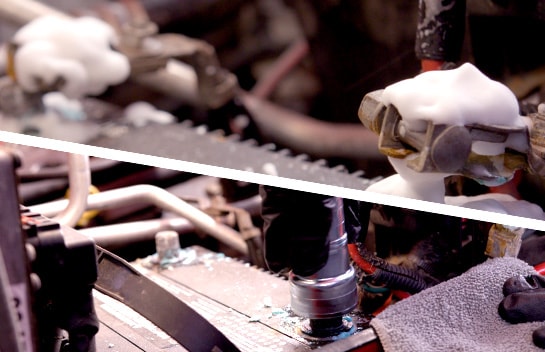
The battery cleaner foam sits to remove any corrosion. Our expert uses a battery brush to work off any corrosion not removed by the cleaner.

Wait a few minutes while the cleaner neutralizes surface acids, salts and corrosion. If needed, you can use a battery brush for heavy deposits on terminals and connectors. After a few minutes, flush the area with water and wipe it down with a clean, dry shop towel or rag. Repeat this process if necessary.
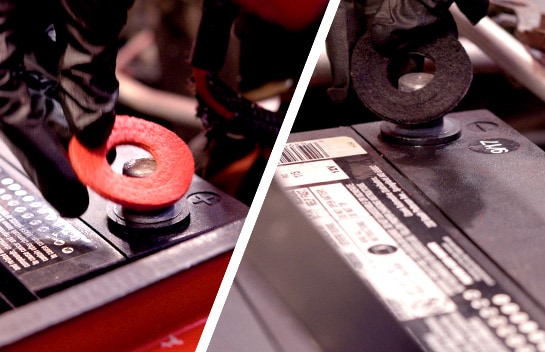
Battery terminal protectors are installed.

Step 3: Install Your Terminal Protectors

Once the battery terminals and the surrounding surfaces and connectors are clean and dry, install your terminal protectors. They go right over the positive and the negative posts.

These terminal protectors are infused with an anti-corrosion agent that forms a barrier to help prevent corrosion and prolong battery life.
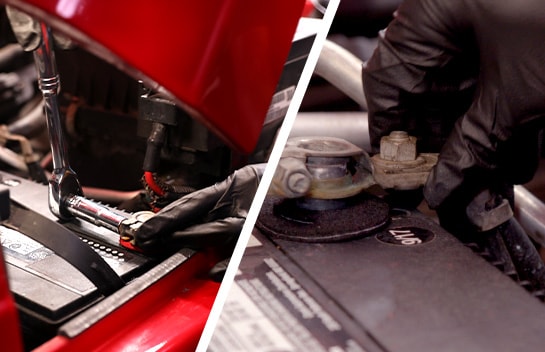
In two images, our expert reattaches the battery cables, starting with the positive cable and then the negative cable.

Step 4: Reconnect Your Battery Cables

Reconnect your battery cables, starting with the positive cable then the negative.
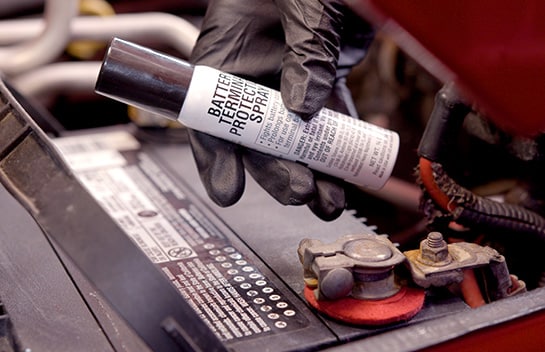
Our expert holds a small spray can of battery terminal protective spray.

Step 5: Apply Your Terminal Protector Spray

Take your terminal protector spray and shake the can well. Hold it 10 to 12 inches from the surface and spray down the battery tray, hold-down, terminal cables and battery posts.
In two images, battery terminal protective spray is applied to the battery tray, leaving a red-colored foam.

This spray will help increase battery life by resisting corrosion and ensuring strong terminal connections.

After applying the protector spray, close the hood of your vehicle.

Additional Resources

The automotive repair work depicted in this series is performed under the direction of the manufacturer of the product featured. Prior to undertaking any of the demonstrated repairs on your vehicle, we suggest you consult with a certified mechanic or another professional who can adequately advise you of the proper repair or remedy required. O’Reilly Automotive Stores, Inc. and its affiliates (“O’Reilly”) disclaims any responsibility for injury or damage resulting from a viewer’s attempt to recreate the repairs shown in this series.