Warning Sorry, you're using a web browser that is no longer supported. For the best experience please upgrade or visit the site on another browser.
Skip to content

How to Locate and Read Your Vehicle’s VIN Number

Your Vehicle Identification Number (VIN) is a unique 17-character code that identifies your vehicle’s specifications, origin, and configuration. You can find your VIN Number on the dashboard, door jamb, or official documents, and it can be used to confirm the correct parts, verify ownership, and understand your vehicle’s build details.

Every vehicle has a VIN Number that acts like a fingerprint—no two are the same. Learning how to locate and read your VIN can help you find the right parts faster, avoid compatibility issues, and better understand your vehicle’s features. Tools like the O’Reilly Auto Parts VIN Lookup can also help decode your VIN Number and match parts accurately.

Why Is a VIN Important?

A VIN Number is essential for identifying your vehicle’s exact specifications and ensuring compatibility when purchasing parts or performing repairs.

Each VIN Number contains detailed information about your vehicle, including:

  • Year, make, and model
  • Engine type and size
  • Trim level and configuration
  • Manufacturing location

This information is critical when selecting replacement parts, especially for vehicles with multiple engine or trim variations. It is also used for registration, insurance, recalls, and verifying vehicle history.


Where Can You Find Your Vehicle’s VIN Number?

Your VIN Number is typically located in several places on the vehicle and in official documents. Here are common VIN Number Locations on a Vehicle:


Locate vin number on stick on inside of car door

Driver-Side Door Jamb

The VIN Number is often printed on a sticker inside the driver-side door jamb. This is one of the most accessible and commonly used locations.

A-Pillar or Door Frame

Some vehicles include VIN Number labels on structural components like the door frame or A-pillar.

VIN number on car dashboard

Dashboard (Visible Through the Windshield)

You can usually see the VIN Number through the windshield on the driver-side dashboard without opening the door of the vehicle. This is often the area that inspection stations and shops will use, since the A-pillar or door frame sticker may have been damaged or faded over time.

Other Locations on the Body

The VIN Number may in some cases also be etched or stamped into areas on the vehicle like the frame, firewall, windows, and more. This is less likely to be used for identifying the vehicle itself, but can be a valuable tool for law enforcement when attempting to identify stolen vehicles or parts which may have had the typical VIN Number locations damaged or removed.

Title and insurance for vehicle

VIN Number Locations on Documents

You can also find your VIN Number on:

  • The vehicle’s title
  • Your insurance cards
  • In your owners manual

Having multiple VIN Number locations helps verify accuracy and ensures the vehicle can be properly identified, but if you need your VIN Number for any paperwork or registration purposes, the above resources may be more accessible.

How Is a VIN Number Structured?

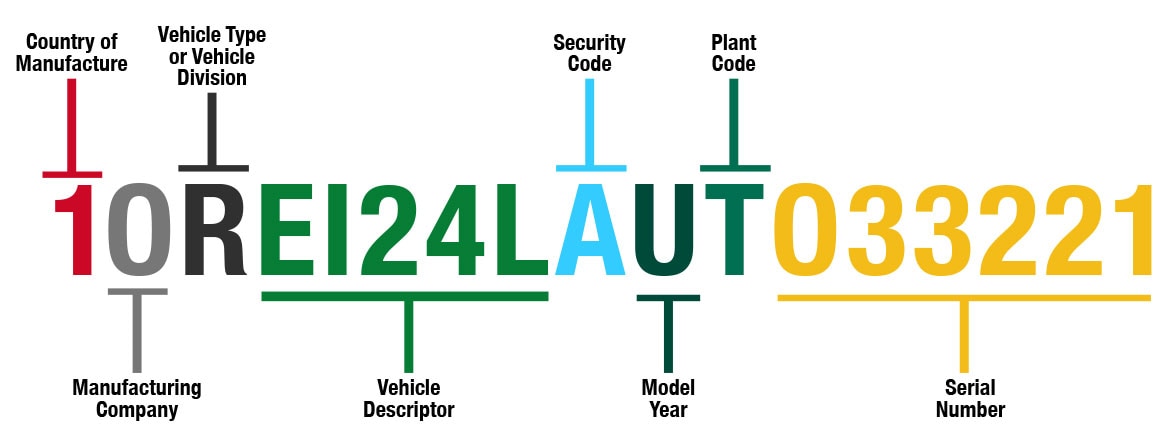
Since 1981, VIN Numbers have been made up of 17 characters, and each position represents specific information about the vehicle. Prior to 1981, VIN Numbers were not standardized, and specific lookup or decoding tools or a trim plate affixed to the vehicle may be needed to determine some of the information that is included in a modern VIN.


VIN Number Breakdown by Section

Characters 1–3: Manufacturer Identifier (WMI)
Identifies the country of origin, manufacturer, and vehicle type.

Characters 4–8: Vehicle Description
Provides details such as model, engine type, body style, and transmission.

Character 9: Check Digit
A security code used to verify that the VIN Number is valid.

Character 10: Model Year
Indicates the vehicle’s production year.

Character 11: Assembly Plant
Specifies where the vehicle was manufactured.

Characters 12–17: Serial Number
A unique identifier assigned to each vehicle.

Even vehicles with identical features will have different serial numbers, making each VIN Number unique.


Why Using a VIN Number Helps You Find the Right Parts

Using your VIN Number ensures that the parts you choose match your vehicle’s exact configuration.

Many vehicles have variations within the same model year, including:

  • Different engine options
  • Trim-specific components
  • Drivetrain variations

Without using a VIN Number, it’s easy to select parts that appear correct but don’t fit properly. VIN Number-based lookup tools eliminate this risk by using factory data to match parts accurately.


When Do You Need Your VIN Number?

You may need your VIN Number anytime you need to verify or identify your vehicle.

Common situations include:

  • Ordering replacement parts
  • Checking for recalls
  • Registering or selling your vehicle
  • Requesting insurance coverage or filing insurance claims
  • Reviewing vehicle history reports

Law enforcement and manufacturers also use VIN Numbers to track stolen vehicles and issue recall notices based on registration data.


Why Accurate VIN Number Matching Matters

Using incorrect vehicle information can lead to ordering the wrong parts, which may delay repairs or create safety risks. Even small mismatches in engine size or trim can result in incompatible components.

Accurate VIN Number matching helps ensure:

  • Proper fitment
  • Reliable performance
  • Fewer returns or exchanges
  • Faster and more efficient repairs

VIN Number Lookup vs Manual Vehicle Selection

VIN Number lookup provides more accurate results than manually selecting your vehicle.

VIN Number Lookup:

  • Uses factory-specific data
  • Minimizes errors
  • Best for precise repairs

Manual Selection:

  • Faster for browsing
  • Depends on correct input
  • Higher risk of mismatch
  • May be necessary if original equipment has been changed

For most repairs, VIN Number lookup is the more reliable option.


Can a VIN Number Help With Buying a Used Car?

Yes, a VIN Number can be used to check a vehicle’s history and verify its details before purchase.

By using a VIN Number, you can:

  • Confirm vehicle specifications
  • Review accident or service history
  • Verify ownership records
  • Check for recalls

This helps ensure transparency and reduces the risk of purchasing a vehicle with hidden issues.


Frequently Asked Questions

Do all vehicles have a 17-digit VIN Number?

Most vehicles manufactured after 1981 use a standardized 17-digit VIN Number. Older vehicles may have shorter VIN Numbers and may require specific decoder tools or resources to identify them accurately.

Can two vehicles have the same VIN Number?

No, every VIN Number is unique to a specific vehicle.

Can a VIN Number tell you engine size?

Yes, a VIN Number can provide details about engine size, configuration, and other factory-installed features.

Where can I find my VIN Number?

Your VIN Number is typically located in multiple places, including the dashboard near the windshield, a sticker on the driver-side door jamb or A-pillar, and on documents such as your vehicle title, insurance card, or owner’s manual.


Understanding Your VIN Number Makes Vehicle Maintenance Easier

Knowing how to locate and read your VIN Number helps you make more informed decisions about your vehicle. From identifying the correct parts to verifying specifications, your VIN Number plays a key role in maintenance, repairs, and ownership.

For added convenience, tools like the O’Reilly Auto Parts VIN Lookup can help decode your VIN Number and match you with the right parts quickly and accurately.