Warning Sorry, you're using a web browser that is no longer supported. For the best experience please upgrade or visit the site on another browser.
Skip to content

How to Change the Oil in a 2014 to 2019 Toyota Highlander

Complete an oil change in your 2014 to 2019 Toyota Highlander with these helpful step-by-step instructions from O’Reilly Auto Parts.

Tools & Materials

Instructions for Changing the Oil in your Toyota Highlander

Regularly changing the oil and replacing the oil filter in your Toyota Highlander helps ensure you have clean, filtered oil to lubricate and cool the vehicle’s engine components and keep your engine performing its best. Dirty or contaminated oil, low oil levels, and clogged oil filters can all contribute to premature engine damage, overheating, or wear. These step-by-step instructions and video detail how to change the oil in a 2017 Toyota Highlander, and will be similar for most 2014, 2015, 2016, 2018, and 2019 Highlander models.

Before changing your oil, be sure to consult your owners manual for maintenance instructions specific to your vehicle. Your owners manual should tell you how often you need to change your oil and oil filter, as well as the type and weight of oil recommended for your Highlander. It’s important that oil level and condition is checked regularly to prevent engine damage or failure. If you are experiencing reduced engine performance, engine noise, oil discoloration, or low oil levels, more frequent oil changes on your Highlander may be necessary to prevent further engine damage. Maintain your engine health and keep your vehicle on the road with regular oil changes using these step-by-step instructions.


Drain Oil

Our O'Reilly expert lifts the hood of a 2017 Toyota Highlander

Step 1: Prepare Your Vehicle

Park on a level surface and open the hood.
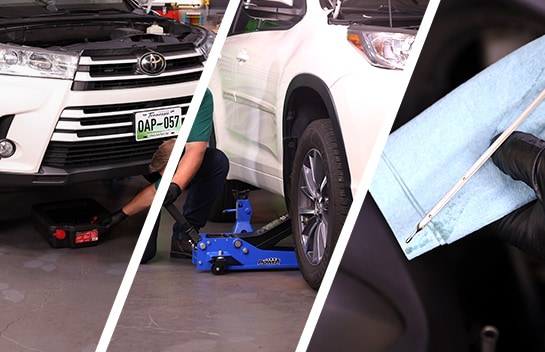
In two images, the Highlander's back wheels are chocked and the front end is lifted with a Power Torque jack.

Do It Right: If needed, chock the rear wheels and lift and support the front end of the vehicle.

Our expert uses a ratchet and socket to remove the bolts of the splash shield.

Step 2: Remove Your Splash Shield

Remove the splash shield under the front end using a trim tool or flathead screwdriver to remove the push clips and a ratchet and 10mm socket to remove the bolts.
Our expert drains the Highlander's old oil into an oil drain pan.

Step 3: Drain Your Old Oil

Locate the oil drain plug and position your drain pan underneath it. Use your ratchet and 14mm socket to loosen the oil drain plug. Remove it by hand and let the oil drain completely.
The oil fill cap is removed.

You can also remove the oil fill cap on the engine to allow the oil to drain more quickly.
The old oil filter is removed from the Highlander with our expert using a drive socket extension.

Step 4: Remove Your Old Oil Filter

Locate the oil filter housing. The housing itself will have a drain plug at the bottom. Use a 3/8-inch drive extension to loosen the drain plug and remove it by hand.
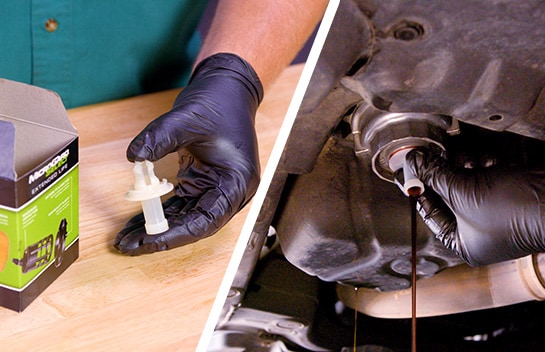
In two images, our expert removes a new plastic drain tube from a MicroGard oil filter box and connects it to the old filter to drain the rest of the old oil

Step 5: Connect Your Oil Drain Tube

Locate the plastic drain tube included with your new filter. You can fit a 15mm hose to the drain tube before you attach it to the filter housing, or set your drain pan under the filter when you attach the tube. Insert the drain tube at the bottom of the filter housing and let the oil drain.

Remove Old Filter

In three images, the oil filter, drain tube and old O-rings are removed.

Step 6: Remove Your Old Old Filter and Drain Tube

Once the filter has completely drained, squeeze the drain tube on either side to remove it from the housing. Attach your filter wrench to your 3/8-inch drive extension to loosen the filter housing then remove it the rest of the way by hand. Remove the old filter and the two O-rings from the housing.
In three images, our expert wipes down all the areas around the oil filter housing to prepare for a new oil filter and adds new O-rings to the filter housing.

Step 7: Wipe Away Excess Oil

Use a shop towel or rag to wipe down the filter housing the drain plug, the filter mounting area and the drain plug port. Install the two new O-rings on the filter housing and lubricate them with some fresh oil.

Install New Filter

The new oil filter is inserted into the filter housing and both components are reinstalled into the Highlander.

Step 8: Install Your New Filter

Install your new filter in the housing and thread the housing into place by hand. Use your 3/8-inch drive extension with a torque wrench and filter wrench attachment to tighten the filter housing to 18 foot-pounds.
Our expert use a drive torque wrench to tighten the housing drain plug.

Reinstall the filter housing drain plug, and tighten it to 9 foot-pounds using your 3/8-inch drive torque wrench.
Our expert secures the drain plug bolts by installing a new crush washer on the plug, threading it into place by hand.

Step 9: Secure the Drain Plug Bolts

Install a new crush washer on your drain plug, and thread it into place by hand. Use your torque wrench and 14mm socket to tighten the drain plug to 30 foot-pounds.

Refill Oil

Fresh SYNTEC High Mileage oil is poured into the oil pan.

Step 10: Add Fresh Oil

If you haven’t already, remove the oil fill cap in the engine bay and add your fresh oil.

Do It Right: This Toyota Highlander takes 5.8 quarts of 0W-20. Our vehicle has over 75,000 miles, so we’ll be using SYNTEC Full Synthetic High-Mileage.

Our expert tightens the fill cap.

Step 11: Check Your Oil Levels

Once the oil is refilled, tighten the fill cap back in place and run the engine until it’s warm. Check under the vehicle for any oil leaks. If everything looks good, it’s safe to shut off the engine and reinstall the splash shield using the fasteners you removed earlier.
The Toyota Highlander's back wheel chocks are removed and the vehicle is lowered to the floor. Our expert examines the oil dipstick to check the new oil levels.

Step 12: Lower Your Vehicle

Lower the front end and remove the wheel chocks. Double-check using the dipstick to make sure the oil level is within the appropriate range. Once you’ve verified the oil level, you can shut the hood.

Reset Oil Change Notification – Monochrome Display

The Highlander's display shows a notification that the vehicle is on. Our expert holds down a button on the steering wheel.

Use the DISPLAY CHANGE button at the bottom of the gas gauge to switch the display to trip meter “A” while the engine is running. Turn the engine switch back to the LOCK position, or with a smart key, switch the engine to OFF. Now press and hold the DISPLAY CHANGE button and turn the engine switch to the ON position without starting the engine. Continue to press and hold the button until the trip meter displays zeroes (00000).

Reset Oil Change Notification – Multi-Information (or Color) Display

The Highlander's display shows the ignition is on but also highlights "Scheduled Maintenance" and notes that selecting this option would reset the maintenance data.

Turn the ignition switch to ON. Using the steering pad switch assembly, find the SETTING display on the multi-information display. Select MAINTENANCE from the setting display and perform INITIALIZATION. A confirmation message will be displayed when the reset procedure has finished.

Additional Resources

These step-by-step instructions and video detail how to change the oil and replace the oil filter in a 2017 Toyota Highlander, and will be similar for 2014 through 2019 models. Completing oil changes and replacing the oil filter as specified in your owners manual helps ensure you have clean oil to lubricate critical engine components. Going too long between oil changes may result in poor engine performance, engine noise, or oil degradation, and can lead to costly engine damage. To learn more about the oil in your Toyota Highlander, take a look at our other resources, including which oil is right for your vehicle and how to change your motor oil and filter.


The automotive repair work depicted in this series is performed under the direction of the manufacturer of the product featured. Prior to undertaking any of the demonstrated repairs on your vehicle, we suggest you consult with a certified mechanic or another professional who can adequately advise you of the proper repair or remedy required. O’Reilly Automotive Stores, Inc. and its affiliates (“O’Reilly”) disclaims any responsibility for injury or damage resulting from a viewer’s attempt to recreate the repairs shown in this series.